.avif)

We just spent two days sitting side-by-side with a Fortune 500 brand, sharing and workshopping our entire strategic and creative process.
Not the sanitized version. The actual frameworks. The persona development methodology we've refined over hundreds of B2B engagements. The messaging foundations that turn product features into buyer value. The program planning architecture that transforms single assets into integrated campaigns. The content multiplication system that scales one piece of hero content across channels and formats. The visual storytelling principles that make complex concepts digestible.
We handed over the templates.
And here's what surprised us: it was as much a learning opportunity for our team as it was for theirs.
When you stop presenting and start workshopping, you discover gaps in your own thinking. Their field intelligence challenged our assumptions. Their operational realities forced us to refine frameworks we thought were bulletproof. The questions they asked revealed blind spots we didn't know we had.
This is StoryCraft. And it's built on a simple premise: the more capable your clients become, the more valuable you become to them.
It starts before the strategy
Before we opened a single deck or introduced a framework, we did something different.
We started with The Other Side Story, an illi icebreaker where participants introduce each other instead of themselves. It's unexpected. A little vulnerable. And it helps the room feel human right from the start.
This isn't a gimmick. It's a reflection of our core belief: empathy with edge, connection with clarity, and finding the magic on the other side. By flipping the script, we trade pressure for perspective and create space for trust before diving into frameworks.
And it sets the tone for everything that follows.
Strategy, Story, Scale: The StoryCraft framework
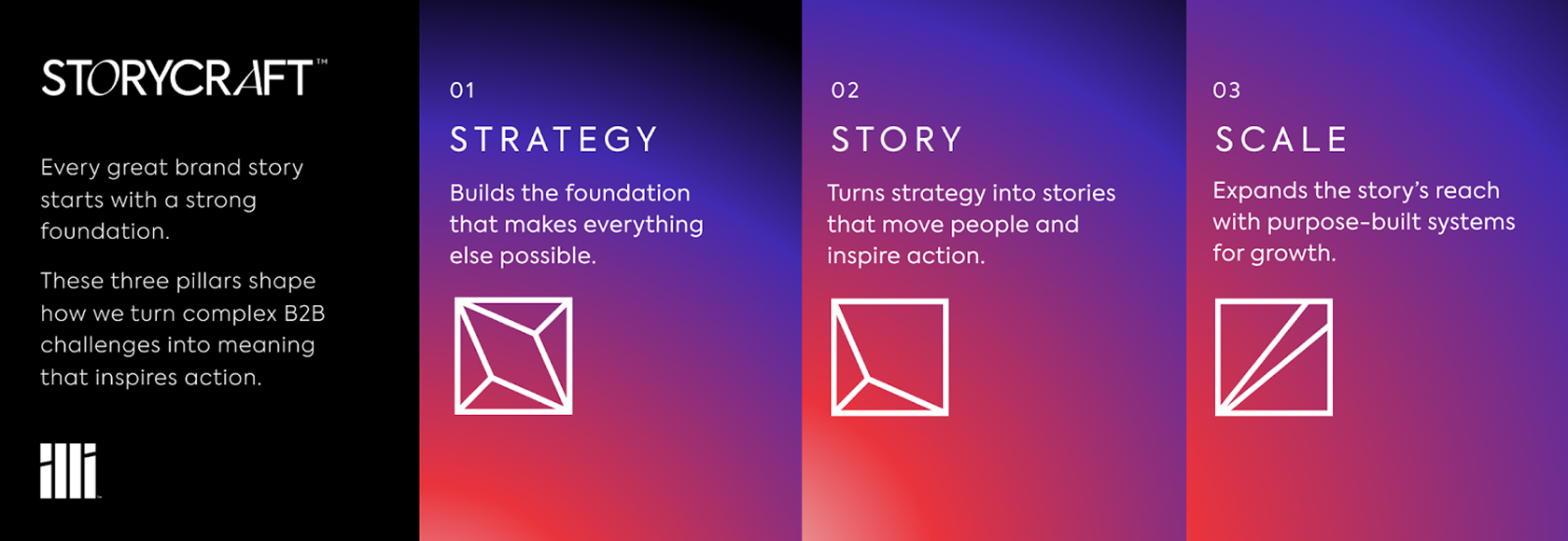
The workshop is structured around three foundational pillars that shape how we approach all B2B marketing work:
STRATEGY builds the foundation that makes everything else possible
STORY translates strategy into narratives that connect with buyers
SCALE multiplies impact through systematic content architecture
Most agencies treat these as separate workstreams. We've learned they're interdependent. And when you develop them collaboratively, the results compound.
Day 1: Strategy + Story
The first day focuses on strategic foundation and narrative development:
Persona Development We don't create generic buyer profiles. We workshop personas using their field intelligence: the conversations their sales team is having, the objections buyers raise, the language customers actually use. Our methodology structures this intelligence into actionable buyer insights.
Competitive Analysis Not just feature comparisons. We identify white space in how competitors position themselves, revealing opportunities for differentiated messaging. Where are competitors vulnerable? Where are they overinvested? Where do they sound identical?
Messaging Foundations This is where strategy becomes story. We develop messaging frameworks that connect their innovations to buyer needs, translating technical capabilities into transformation narratives. The goal isn't clever taglines. It's a systematic approach to articulating value that anyone on their team can apply.
Content Architecture Planning How does a brief become a brand asset? We map the journey from source material (white papers, case studies, product specs) to audience-ready content. This isn't about individual campaigns. It's about building a repeatable system.
Day 2: Scale
The second day shifts to program planning and content multiplication:
Campaign Program Planning How do you turn one piece of hero content into an integrated, multi-touchpoint initiative? We workshop the architecture: which channels, which formats, which sequences create genuine buyer engagement rather than just coverage.
Brief Development We systematize how to extract strategic insights from source material. What makes a brief actionable? How do you translate technical depth into creative direction? The team leaves with templates and decision-making frameworks they can use immediately.
Content Multiplication One white paper can become: a social carousel breaking down complex concepts, a podcast episode with deeper executive dialogue, a blog post optimized for search and discoverability, an infographic for specific personas. We workshop how to identify the right derivatives for each audience and channel.
Visual Storytelling We share our principles for creative direction. How to clarify the complex through illustration, how to establish visual consistency that reinforces brand, how to control the narrative through bespoke imagery rather than stock.
Capability Assessment We close by identifying gaps: What tools and templates do they need? Where do workflows break down? What cross-functional partnerships are missing? How should team collaboration be structured? This ensures the workshop doesn't end with inspiration. It ends with an implementation roadmap.
Why this doesn't cannibalize our business
When we partner with B2B brands on complex marketing initiatives, we don't just create campaigns. We make their internal teams the heroes of the transformation. We connect them to industry use cases, explore innovation strategies together, and shape insights that link their capabilities to audience needs.
The result? They get better at strategic thinking, storytelling, and scaling programs. And when they get better, they need us more. Not for execution they can now handle themselves, but for the next level of complexity they're ready to tackle.
And we get better too. Every StoryCraft workshop surfaces new challenges, edge cases, and real-world constraints that sharpen our thinking. Their questions become our R&D. Their implementation struggles become our process improvements. The learning runs both ways.
Here's what most agencies miss: 68% of clients leave agencies citing "lack of strategic guidance" as the primary reason, not bad execution. They're not leaving because they learned too much. They're leaving because they're not getting smarter about their own business.
The capability maturity progression
Through work with dozens of B2B brands, we've identified how agency-client relationships evolve:
Level 1: Dependency Traditional vendor relationship. Client briefs, agency executes. Knowledge stays siloed.
Level 2: Collaboration Clients participate in strategy sessions but still rely on agency for program planning and execution.
Level 3: Partnership Joint capability development. Shared frameworks. Client teams can replicate processes independently.
Level 4: Empowerment Client has internalized core capabilities across strategy, story, and scale. Agency becomes advisor on increasingly sophisticated challenges.
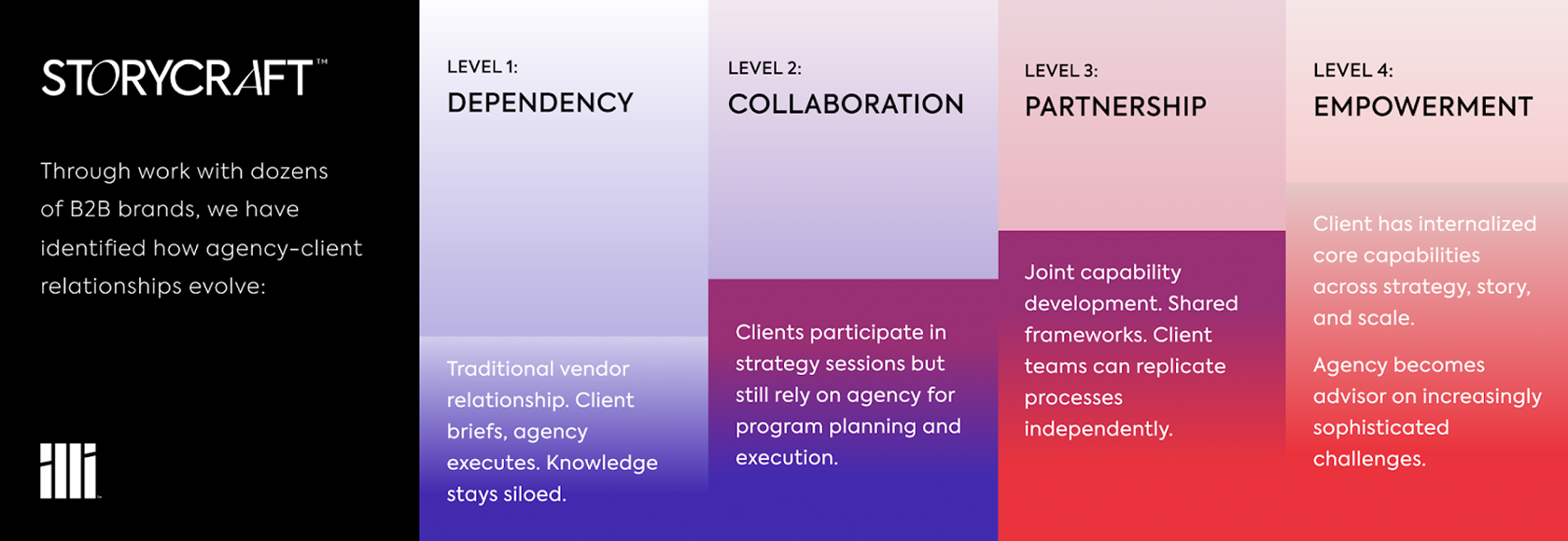
Most agencies try to keep clients at Level 1 or 2. We're engineered to reach Level 4, because that's where the most interesting work happens.
When clients understand personas deeply, we can explore advanced segmentation strategies. When they've mastered messaging frameworks, we can tackle positioning against emerging competitive threats. When their teams can plan integrated programs and multiply content effectively, we can focus on orchestrating campaigns across increasingly complex stakeholder maps.
The sophistication spiral only works if both sides keep leveling up.
Why most agencies won't make this shift
Fear. Specifically, three fears:
- Fear of commoditization: "If we share our process, they won't need us"
- Fear of reduced perceived value: "Mystery creates premium pricing"
- Fear of competitive disadvantage: "Why would we arm clients with our IP?"
All three fears ignore what actually creates sustainable competitive advantage in B2B agency partnerships: being so good at capability development that clients can't imagine growth without you.
The shift from vendor to growth partner
At illi, we don't just bridge brands and buyers. We empower teams to build those bridges themselves. Because we've learned that knowing a brand well does more than close buyer gaps. It transforms businesses from the inside out.
The StoryCraft Deep-Dive is our most concentrated expression of this philosophy. Two days where we don't perform expertise. We share and workshop it. Strategy, story, and scale developed collaboratively.
And here's what we've discovered: clients who complete StoryCraft don't fire us. They bring us deeper into their organizations. They introduce us to other divisions. They invite us into strategic planning cycles we'd never access as traditional vendors.
Not because they need us to execute the basics. Because we've proven we're invested in their success more than our retainer. And because the collaborative process reveals we're still learning too: from their markets, their constraints, their innovation challenges.