
Plutchik's Wheel of Emotions, the most widely cited model in emotional psychology, often gets misread in marketing circles. Trust and fear are often assumed opposites, which on the surface makes sense, but it’s not true.
Fear’s opposite is anger. Trust’s opposite is disgust. What trust and fear are, on the wheel, is adjacent, and that adjacency teaches us a lot more than any simple opposition would.
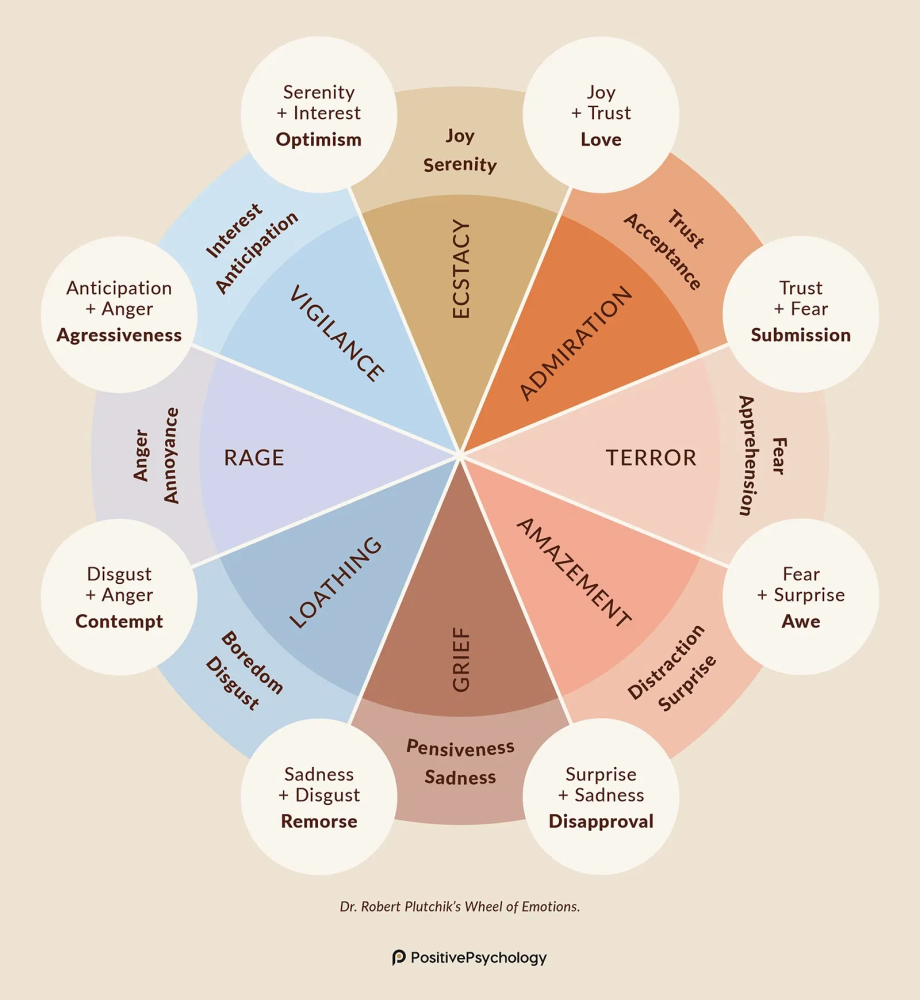
When the two combine, Plutchik’s model identifies the emotional dyad they produce as submission. Not confidence. Not decision.
Submission.
Persuasion strategies built on fear are not building trust, they are manufacturing compliance, at best. And compliance alone does not hold once the buyer is out of the room and back in front of their committee.
Our intention is to foster trust, but what we see in B2B marketing is that these attempts to build trust are accidentally amplifying fear. Neuroscience explains why this is so hard to catch.
Bear with me while I nerd out for a moment:
Cambridge’s work on the neurobiology of trust shows that fear-adjacent states such as anxiety and threat response directly suppress the brain activity associated with trust decisions, specifically in the temporoparietal junction and medial prefrontal cortex, the parts of the brain that read intent and evaluate whether someone is trustworthy.
When the amygdala fires, cortisol floods the system and shuts down the open, approach-oriented neural state that trust requires. Research published by ABC Religion and Ethics puts it plainly: fear drives out trust and replaces it with distrust, and once the loop is running it becomes progressively harder to break.
This is the same cornerstone we built our Motivation Momentum Mapping (MMM)™ around.
The four Technical Buyer Archetypes in MMM are each operating from a distinct fear state when they encounter your messaging.
- The Operations Guardian fears being blamed when something breaks.
- The Technical Modernizer fears becoming irrelevant while the field moves.
- The Regulatory Protector fears the compliance gap that ends careers.
- The Business Builder fears the ROI story will not hold under scrutiny.
These are not personas or demographics. They are neurologically grounded states a buyer is in before your content ever reaches them.
The mistake being made in B2B content is usually one of two things: ignoring those fear states, which simply means your content will not connect, or leaning into them to generate urgency, which triggers the distrust loop Plutchik describes.
Content that leads with everything that could go wrong is activating the amygdala of every Operations Guardian and Regulatory Protector in the room. It might generate short-term attention. They may do the thing. What it is not doing is generating trust, and it certainly will not produce the decision confidence that closes complex deals.
What Plutchik’s model points to instead are confidence and security, not as the opposite of fear on the wheel, but as the psychological conditions under which fear can resolve.
This tracks with where @Gartner's sense making research has landed on the seller side. Their work shows that decision confidence, not urgency, is what predicts good outcomes for both buyer and seller. Sense making describes what a seller should do in the room. MMM describes the emotional state the buyer is already carrying when they walk in. Decision confidence is what your buyer carries back into the room when you're not there. It's what holds up under questioning from the people who weren't on your call.
These are, not coincidentally, the same preconditions under which trust becomes possible.
So the way to build sales and buyer enablement collateral that moves technical buyers is not “Go identify the fear and amplify it”, it is “Identify the fear state and meet your buyer there with language that makes them feel seen rather than threatened.” We want to build toward the confidence and security that allow trust to form. The fear arc is not a way to manipulate your buyer into submission, it is a diagnostic map for the emotional journey a buyer needs to move through before they trust you.